Welcome to GenOT’s documentation!
GenOT: Generative optimal transport enables spatiotemporal interpolation and generation in cross-platform spatial transcriptomics
- Installation
- Tutorial 1: DLPFC
- Tutorial 2: MOSTA
- Tutorial 3: Mouse_Hippocampus
- Tutorial 4:Mouse_Olfactory(Stero-seq & Slide-seqV2)
- Tutorial 5:Mouse_Brain_Merge_Anterior_Posterior(Section1,2)
- Tutorial 6: DLPFC interpolation
- Environment Configuration & Package Loading
- Data Loading
- Normalize Data
- Visualize adata1, adata2, and adata3.
- Align the input datasets adata1 and adata2 using the PASTE2 algorithm.
- Data Preprocessing
- Run GenOT
- Compute the spatial barycenter.
- Run decoder
- Compute the embedding barycenter for the latent representations.
- Use the trained decoder to transform the embedding barycenter into gene expression values.
- Visualize the PCP4 gene expression across datasets.
- Tutorial 7: MOSTA integration
- Environment Configuration & Package Loading
- Data Loading
- normalize
- Visualize adata1, adata2, and adata3.
- Align the input datasets adata1 and adata2 using the GenOT algorithm.
- Data Preprocessing
- Run GenOT
- Compute the embedding barycenter for the latent representations.
- Visualize the Myl7 gene expression across datasets.
- Tutorial 8: Diff_Tech_MOSTA_integration
- Environment Configuration & Package Loading
- Data Loading
- normalize
- Align the input datasets adata1 and adata2 using the GenOT algorithm.
- Data Preprocessing
- Run GenOT
- Compute the embedding barycenter for the latent representations.
- Use the trained decoder to transform the embedding barycenter into gene expression values.
- Visualize the Col1a1 gene expression across datasets.
- Datasets
- Credits
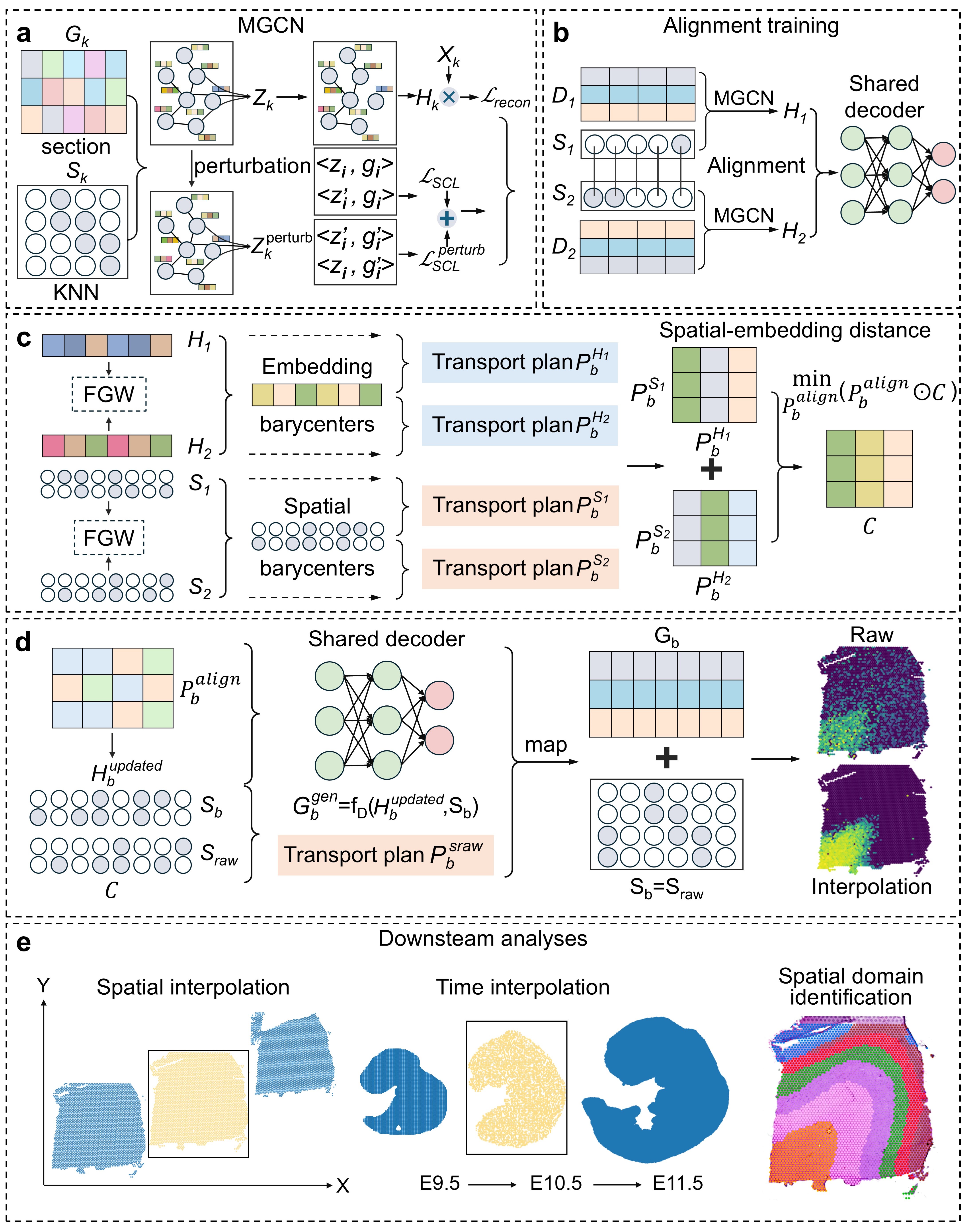
Overview
Spatial transcriptomics (ST) technologies have revolutionized the analysis of spatial gene expression patterns within tissues. However, existing computational methods still face challenges in integrating spatial information and generating cross-heterogeneous sample data. To address this, we developed GenOT - a spatial data generation framework based on graph self-supervised contrastive learning and optimal transport theory. The framework employs a multimodal feature learning architecture to dynamically identify important genes and hierarchically aggregate spatial neighborhood information, achieving high-precision spatial domain clustering and biologically interpretable feature extraction. The core innovation of GenOT lies in introducing an optimal transport barycenter-based interpolation algorithm, which mathematically models cross-sample spatial distribution differences to reconstruct spatiotemporal continuous gene expression dynamics. Experiments on multiple datasets including human dorsolateral prefrontal cortex (10x visium), mouse embryonic development (Stereo-seq), and olfactory bulb/hippocampal tissues (Slide-seqV2) demonstrate that GenOT significantly outperforms existing methods in spatial domain identification, cross-technology platform integration, and developmental trajectory reconstruction. This provides an innovative tool for tissue structure analysis at single-cell resolution and developmental process modeling.
Citation
soon